The numbers Hormozi disclosed are public: trailing-twelve-month revenue grew from $2.5M to $3.6M (+44%), profit from $384k to $540k (+40%), with margin held essentially constant at ~15% across both years.
Hormozi covered the strategy: the offer, the pricing posture, the founder's discipline. That story is real and we recommend watching it.
This case study is about the system that translated strategic decisions into executed custom orders, streamlined lead management, attributable leads, and clear margin data informing where we deployed ad spend for growth. We are the firm that built the operational infrastructure.
Who Optimum Works is.
Optimum Works is a custom-order Shopify manufacturer in the Home & Building category, specifically USA-made metal handrails and railings. Like most businesses in this category, the catalog is real but the average order is configured: dimensions, materials, finishes, mounts, brackets, lead times, and freight class are negotiated per order. Even when a buyer thinks they're “just buying the standard one,” they're not; they're buying a custom-variant of a variant, sized for their specific space (their stairs, their porch, their entryway, their job site).
This is the operational reality of every custom-order manufacturer. It is also the reality that off-the-shelf Shopify is not built for.
When the engagement started in October 2024, Optimum was running on a standard Shopify Liquid storefront, a fragmented set of processes for quoting, and ad spend that wasn't specifically directed towards custom orders. The site converted, but major opportunities were not yet capitalized on and the operating system underneath it was leaking energy at every step: managing segmented email threads, texts, calls, ad spend wasted on traffic that needed a quote rather than a checkout, and no clean source-of-truth for which channel was driving Qualified Calls or generating which kind of order.
The strategic decisions Hormozi covered only work to their full potential when you have the operational system and ongoing strategic management to support scale underneath them.
What we built.
The architecture has three functional regions. An acquisition pipeline at the top: dual-funnel paid ads feeding the Hydrogen storefront, which routes custom-order intent into server-side multistep quote forms. An orchestration layer in the middle: the Optimum Business Ops App, a custom proprietary application that owns the integrations and routes data across the rest of the architecture. And a source-of-truth triad at the bottom: Shopify Draft Orders, HubSpot Deals, and AWS File Uploads, with a bidirectional sync between Shopify and HubSpot as the operational backbone of the entire system.
The Operational Layer
Bidirectional Shopify ↔ HubSpot sync · the backbone of a custom-order workflow
The Backbone
None of the individual systems are novel in isolation. The work was in making them fit a custom-order workflow that specifically matched the way Optimum Works operated, and in making them behave as a single operating system rather than seven disconnected tools.
The Acquisition Pipeline
We rebuilt paid acquisition as a dual-funnel architecture. Handrail Campaigns carry higher transactional intent into product pages for direct purchase, while Railing Campaigns carry greater Request-for-Quote intent that is deliberately driven down a dedicated quoting funnel where every interaction routes into our operational system, whether calls, texts, emails, contact forms, or the main multistep server-side Request a Quote form. Each funnel has separate campaigns, landing pages, creative, and conversion events. Both are tracked, optimized, and reported separately; no decision about ad spend is being made on misleading data that hides which funnel is actually driving profitable sales.
Traffic from both funnels lands on a custom Hydrogen storefront. The Hydrogen site lets the storefront behave like a product catalog for transactional buyers and like a quoting front-door for custom buyers, without forcing one experience to compromise the other.
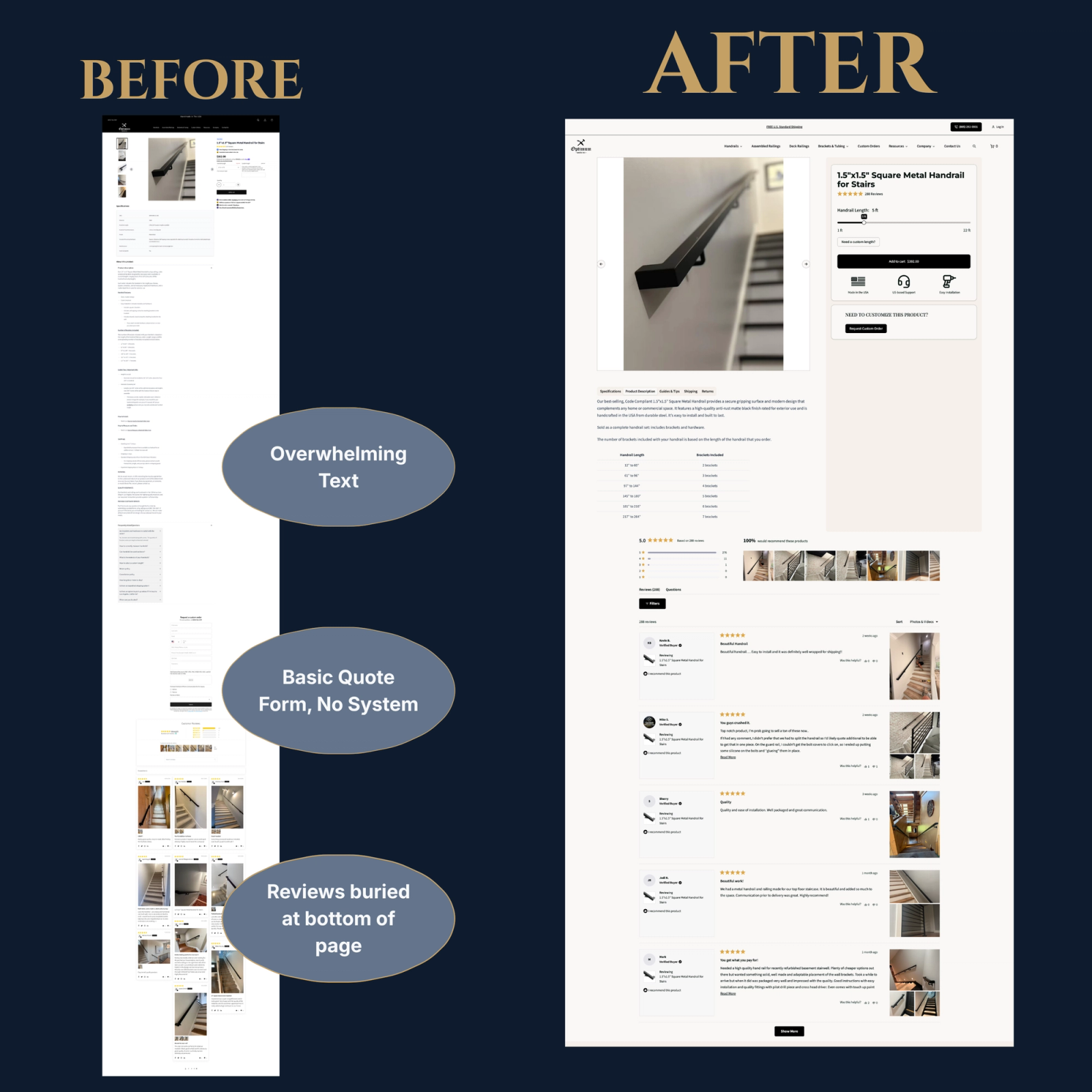
The configurator is the centerpiece of the PDP rebuild. On the best-selling 1.5″×1.5″ Square Metal Handrail (a more transactional product), a slider lets the buyer dial length from 1ft to 22ft, with the Add-to-Cart price updating in real time as the slider moves. A Custom Size button catches any measurement outside the slider range: the buyer enters dimensions in inches, the price recalculates, and they add to cart from there without leaving the page. The same page serves two buyers cleanly: standard-order shoppers move through to checkout; custom buyers escalate to a quote with the product they were viewing already populated in Step 4 of the form. Product descriptions, technical specifications, install guides, and video tutorials are organized into tabs that keep customer reviews high in the scroll and eliminate the wall-of-text problem of the old PDPs.
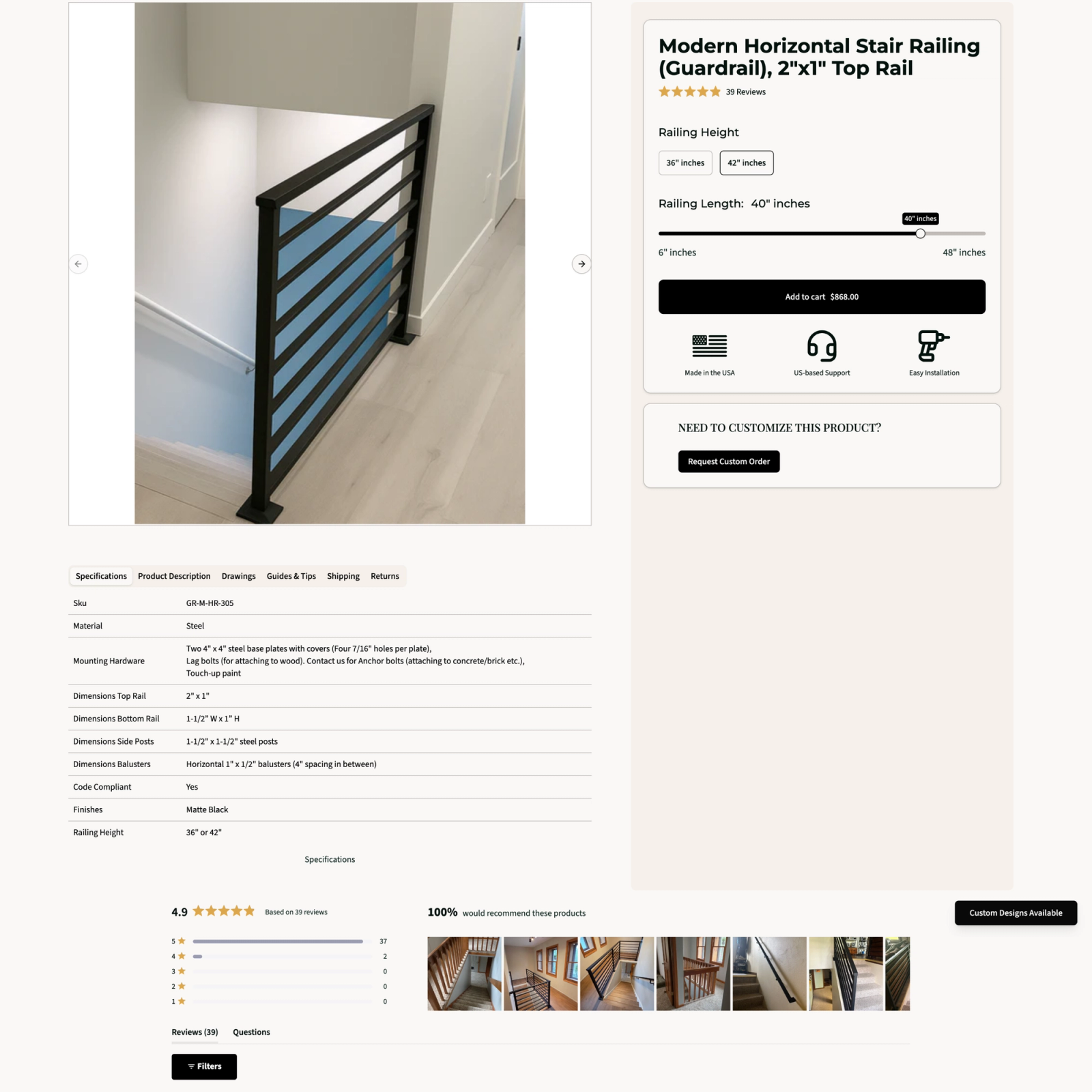
The same configurator pattern scales to multi-axis variants. On the Modern Horizontal Stair Railing (the best-selling railing product, which anchors high-AOV custom orders offline), the configurator handles height and length together. A “Request Custom Order” section on the same page surfaces the path to a fully custom quote without breaking the transactional flow. The product page serves both buyer modes simultaneously: a transactional buyer with a standard configuration can check out; a custom buyer with non-standard specs can initiate the request-a-quote process right from the same page.
The Quoting Infrastructure
The single most overlooked piece of infrastructure in a custom-order Shopify stack is the quote form. Most agencies build them in the storefront's front end: JavaScript on the page, conditional logic in the browser, a submission that lands in an email inbox or a generic CRM contact record. That works for the simplest version of quoting. It does not work for a custom-order business at scale.
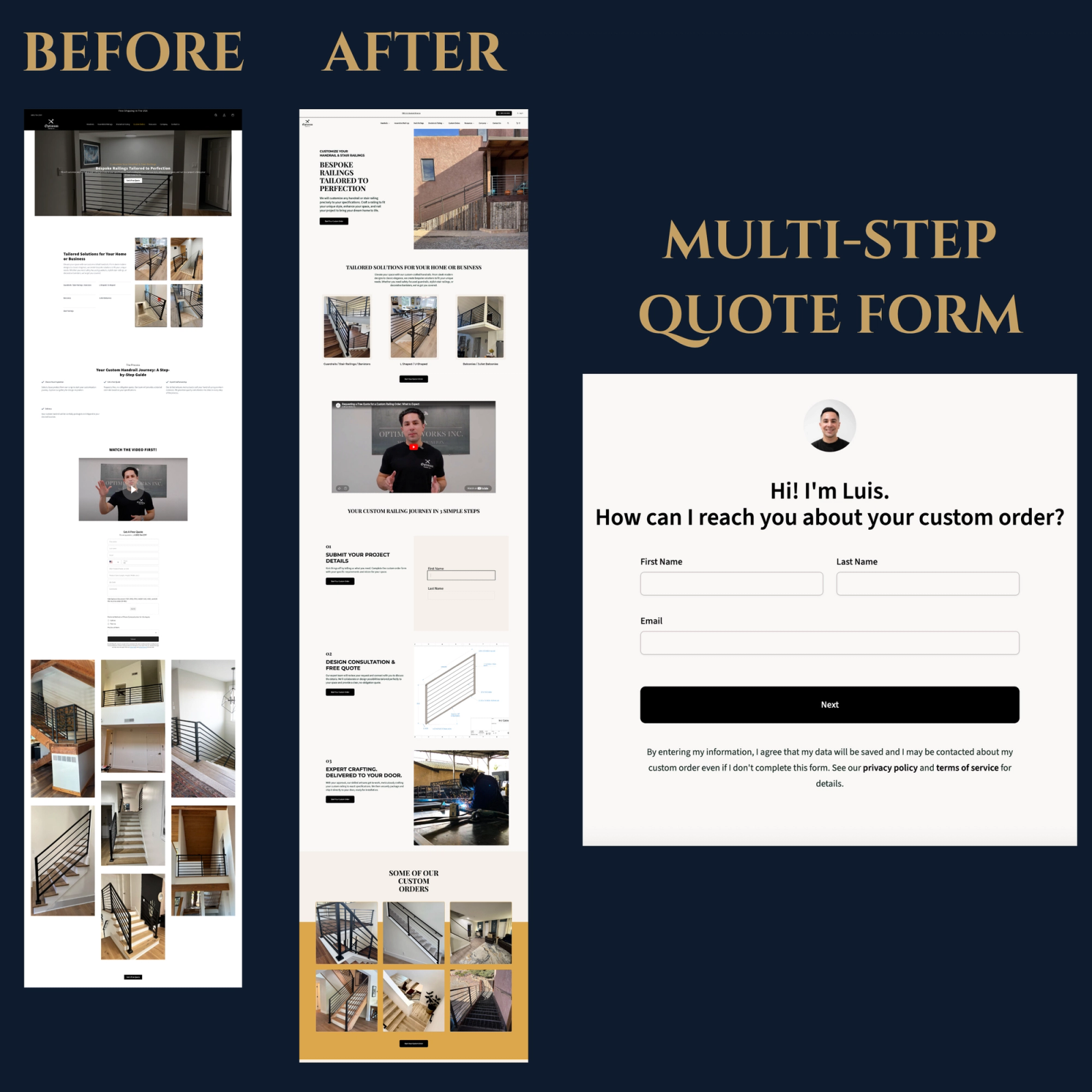
We built the quote forms server-side, multistep, with validation and routing logic running on the server rather than the client. Concretely, that meant:
- +Clean lead data structured for downstream automation
- +No JavaScript-dependent submission failures (silent or otherwise)
- +Search-engine-indexable pathways into specific quoting workflows
- +UTM tracking carried through every step of the form
- +Abandoned-form syncing: partial submissions recovered in dedicated HubSpot workflows
- +Multi-file uploads in a single submission (floor plans, sketches, drawings)
- +Product auto-population at Step 4 when a buyer escalates from a PDP
The Custom Orders page itself, restructured around a three-step journey (Submit Project Details → Design Consultation & Free Quote → Expert Crafting Delivered), became a quoting front-door, not an afterthought form bolted onto a transactional site.
The Orchestration Layer
At the center of the architecture sits the Optimum Business Ops App a custom proprietary application built ground-up for end-to-end custom-order operations. The App is not a marketing app. It is the business's operating system. It routes incoming custom-order requests through the correct workflow, maintains the source-of-truth for order specifications, surfaces the right data to the right person at the right step, and orchestrates the integrations the rest of the architecture depends on.
The Source-of-Truth Triad
Three systems hold the operational data of the business:
The Optimum Business Ops App orchestrates a bidirectional sync between Shopify Draft Orders and HubSpot Deals: the connection highlighted in gold in the architecture diagram above, and the operational backbone of the entire custom-order workflow. On initial form submission, a Draft Order is created in Shopify, then a HubSpot Deal is created and linked to it. Form information and file attachments are stored on the HubSpot Deal. When a deal is worked or updated in HubSpot, it syncs back to the Shopify Draft Order. The team works inside HubSpot for lead management; the final invoice is sent and paid through Shopify. Keeping the data in sync across both systems without manual reconciliation is what makes the workflow scalable at volume. In our experience, most teams in this category are either missing this integration entirely or working around it with duct-taped tools that aren't customized to their actual workflow.
Call Attribution
CallRail and RingCentral feed the system from one more direction. Custom-order buyers call: they want to talk to a human about their unique project needs, they need clarity on measurements, confirm project-critical details, and determine if the lead time works for their deadline. A business that can't attribute those calls to a source channel is flying blind on a meaningful share of its sales. We integrated CallRail and RingCentral so that every inbound and outbound call can be surfaced inside the HubSpot deal record alongside the rest of the customer communications. Every ad-generated lead was tied to a specific campaign, allowing us to double down on campaigns generating high-intent calls versus shutting off AI-Max campaigns generating a flood of spam and low-quality calls during Google's AI-Max rollout phase.
What changed.
Hormozi covered the strategy; Luis worked relentlessly in the business; he made critical strategic decisions and took the risks of investing in them (his mindset and risk tolerance set him apart as a business owner); his team executed; the market cooperated. We helped build and set up the operational system underneath all of that: the product data architecture, Hydrogen, ad campaigns, the Ops App, and the systems. We believe the digital infrastructure was a necessary condition for the growth to be sustainable.
What we can say plainly is what is publicly disclosed and what is verifiable from our own engagement data.
During Frame & Ledger's full-service period, comparing calendar year 2024 to calendar year 2025, we saw 92% year-over-year revenue growth and an 18% improvement in Marketing Efficiency Ratio (MER). This is an apples-to-apples year-over-year comparison that removes seasonality from the calculation, important in a Home & Building category where Q4 holiday demand and spring renovation season generate fundamentally different demand curves.
During Hormozi's measurement window provided by Luis (trailing twelve months from April 2025 versus trailing twelve months from March 2026), the founder publicly disclosed: revenue grew from $2.5M to $3.6M (+44%), profit grew from $384k to $540k (+40%); this signals the profit margin held essentially constant at ~15% across both years.
In a custom-order category where labor and fabrication costs scale with order volume, that is a non-trivial operational discipline.
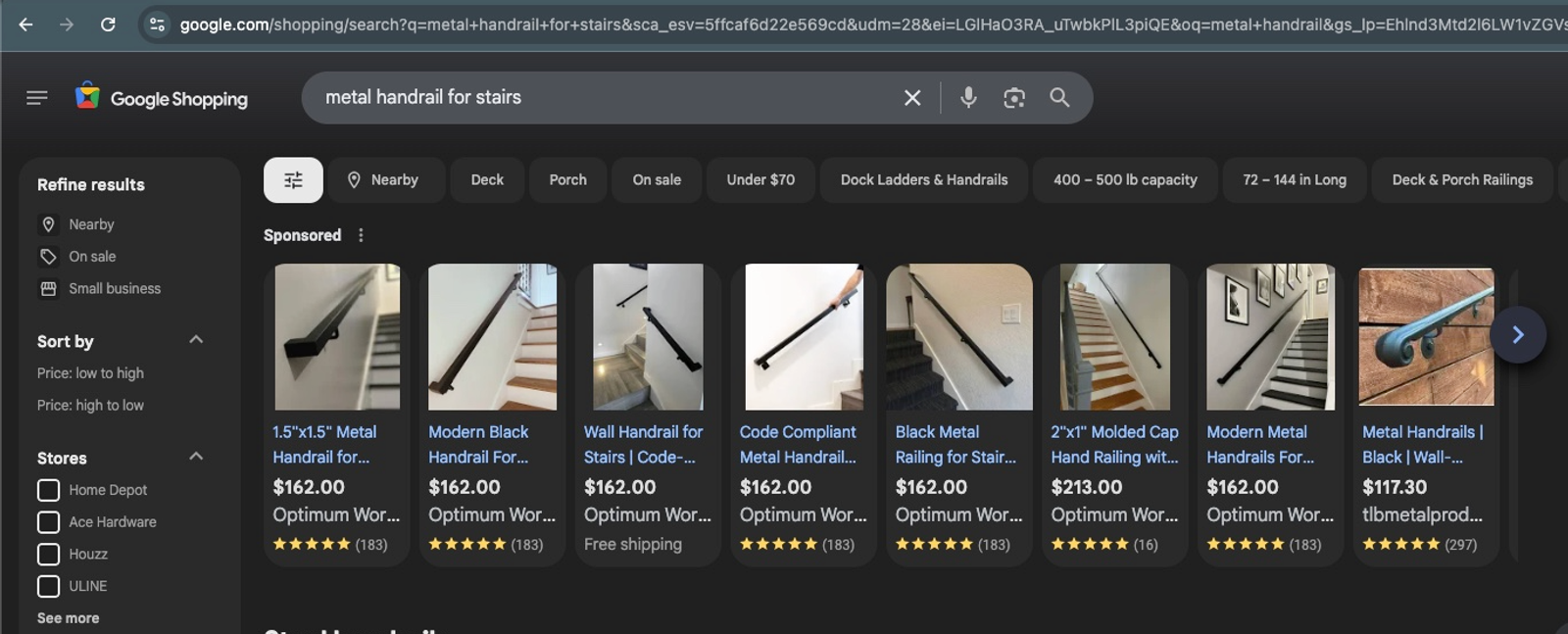
The growth landed in measurable, public ways. We earned a consistent placement as the #1 organic ranking for high-intent searches such as “metal handrails for stairs,” and we were among market-leaders in advertising and organic visibility throughout 2025. We had periods of heavy, market-leading momentum where Optimum dominated Google Shopping ad inventory, such as the category-defining query “metal handrail for stairs,” where seven of the top eight Google Shopping positions were filled.
“Last year we spent twenty-one thousand a month average. This year we've been spending forty-thousand, and our revenue has doubled.”
What the Numbers Don't Show
The disclosed growth reflects what the team could fulfill, not what the system could carry. During parts of the engagement, demand outran capacity. The structural marker of a digital system working as intended is that it stops being the bottleneck and the real-world constraints become visible.
Why this matters for custom-order Shopify manufacturers.
The numbers above are the surface. Underneath them is a category-defining behavior pattern that explains why many custom-order Shopify businesses stall around $1M to $3M in revenue, and why the playbooks borrowed from transactional ecommerce don't carry them through that ceiling.
In a custom-order Shopify category, only ~18% of conversions arrive on Day 0, the day of the ad impression. Roughly 90% arrive within 15+ days. 99% arrive within 27+ days. The remaining 82% live in the tail.
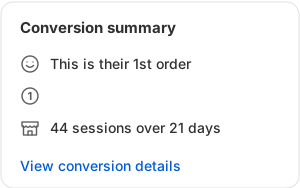
This is the aggregate pattern. At the individual buyer level, the same behavior shows up plainly: it is not uncommon for a custom-order buyer to visit the site forty-plus times across three weeks before placing a single order. They are not researching whether to buy. They are researching what to buy, how it will fit, how to install it, whether the lead time works, what the configuration costs at their exact specifications. Buyer journeys in the 40+ day range are observable. But the odds these journeys get lost (to forgotten interest, competing options, or attribution decay) rise with the length of the buying window. Systems that hold the customer record across that entire window, paired with the ability to evaluate what's actually driving profitable sales, are what let a custom-order business deploy capital confidently rather than guess at it.
Standard ecommerce measurement becomes less true the longer the time to purchase. The longer the window, the more likely there is overlap in platform attribution (Google, Meta, Email) or missed attribution altogether; a direct visit, organic visit, or email visit gets credit when an ad campaign actually drove the sale. In a category where Day-0 returns are potentially less than one-fifth of the actual revenue story, without rigorous evaluation (combining attribution data with judgment about what the data isn't capturing), you'll misinterpret what's driving the growth, inadvertently making decisions that stunt it.
This is the operational reality the entire architecture and relationship was built to serve. Profit-informed ad acquisition driving traffic to a Hydrogen site that serves standard and custom orders equally without diminishing the experience; the server-side, multistep quote form that survives abandoned submissions and partial uploads; the CRM that tracks a deal across thirty days of touchpoints and informs the ad accounts (and managers) when an offline conversion occurs and what campaign drove it; the bidirectional sync between Shopify and HubSpot that keeps the order record and the customer record aligned across a buying cycle that may begin in week one and close in week five.
The architecture isn't fancy. It's correct for the category.
What Frame & Ledger does.
Frame & Ledger operates as a specialized infrastructure firm for custom-order Shopify manufacturers, Home & Building in particular, and adjacent custom-order categories where the operational complexity rewards purpose-built systems.
Foundational Shopify Infrastructure for Custom Manufacturers.
We build the operational layer underneath the business (margin evaluation, product data architecture, storefront, proprietary apps, CRM integration, quoting infrastructure, ad architecture) so that strategy has something to stand on.
We work with a small number of clients per year. We are the firm for businesses that have a real offer in a custom-order category and need the infrastructure and strategic guidance to carry it to the next phase.
What to read next.
This case study describes work originally performed under Daily Grind Digital LLC during 2024-2026 and now owned, maintained, and continued by Frame & Ledger LLC, the successor entity. Trailing-twelve-month revenue and profit figures cited from the Hormozi window are sourced from the Alex Hormozi YouTube feature (April 2026). Calendar year 2024-vs-2025 growth figures are Frame & Ledger's own measurement of the full-service engagement period.