This case study is about what that foundation looks like when it is built with intent from the beginning.
Who Miner Strong is.
Miner Strong is a B2B2C custom safety apparel manufacturer. The company was founded by a hard-rock miner with roughly twenty years of underground experience who could not find reflective workwear that held up (and that was comfortable) in the conditions he was working in. He started making better gear, first for himself, then for the miners around him.
That is the origin story, and it is the anchor the brand still runs on. Never forget the miner. That is where it started.
Two expansions followed. First, direct-to-consumer beyond the founder’s immediate crew: reflective hoodies and long-sleeve shirts sold under the Miner Strong brand to miners across the US and Canada, with a small following outside mining. Second, business-to-business: mining companies that wanted to outfit their crews in the same reflective gear their miners were already buying and endorsing, printed with their own company logo. That B2B expansion pushed Miner Strong into custom-order manufacturing at real volume.
Custom orders do not scale the way transactional D2C scales. Every order carries specifications, logo placements, approval steps, lead times, and freight considerations. Off-the-shelf Shopify handles the checkout part of that reality and none of the rest. Miner Strong needed operational infrastructure underneath the storefront to make the custom-order side of the business work at scale.
That is where Frame & Ledger’s engagement started.
Data architecture came first.
Before any storefront design work, before any marketing spend was reshaped, before any custom-order flow was built, the first substantial deliverable was a product data architecture that could carry the catalog through every product line Miner Strong could reasonably launch over the next several years.
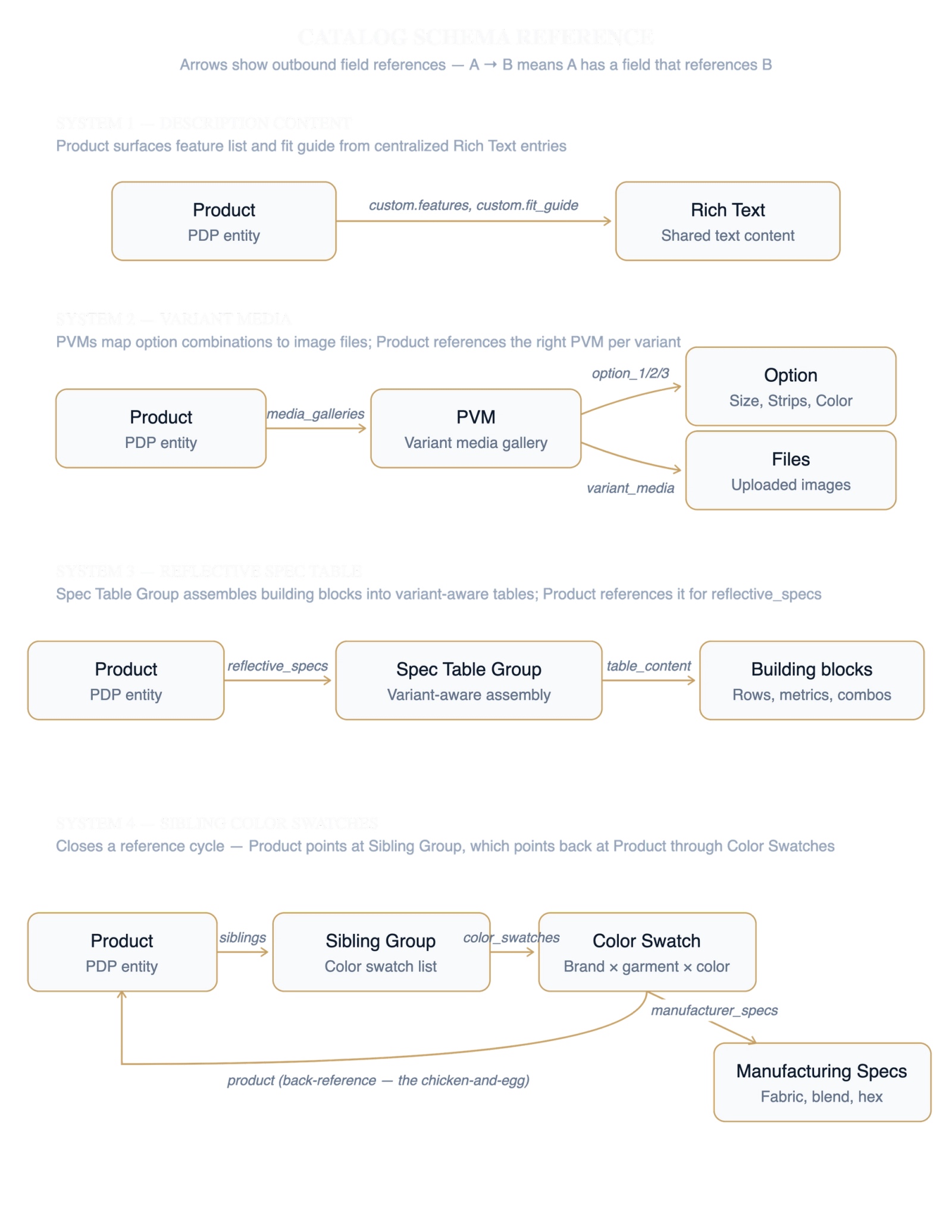
The architecture is built on three principles that drive every downstream decision.
Decoupling over consolidation. Products are split into sibling products by brand, shirt color, and fabric weight. Each sibling gets its own URL, inventory, and SEO surface. The Hydrogen frontend composes those siblings into whatever product experience serves the customer best, with the flexibility to change that composition as the store learns what converts. Reviews are pooled across the family via Shopify Product Groups. This is the opposite of the usual Shopify pattern (one product with many variants), and it is the pattern that lets a serious custom-order catalog carry its weight for search, for merchandising, and for the customer’s ability to move between variations without losing their place.
Linked metaobjects over plain text. Every variant option the storefront branches logic on is linked to a metaobject rather than left as a free-text value. Size, front strip count, strip color, reflective generation, ANSI 107 classification: all validated against an allowlist. The cost is operational (at the time of the build, Shopify’s limitation is that linked options cannot accept new values via bulk import without a hybrid workflow that mixes native creation with subsequent enrichment; Shopify will likely correct this drawback in the future). The benefit is data integrity. A typo cannot crash a page.
Centralization over duplication. Reusable content lives in metaobjects assigned by reference: color swatches, fabric specs, reflective specs, feature copy, fit guides. Edit once, propagate everywhere.
The naming conventions are the invisible spine of all of it. Every SKU, image filename, metaobject handle, and URL slug follows a canonical token pattern that encodes brand prefix, product type, model gender, shirt color, reflective generation, strip color, and size in a predictable order. Titles and product descriptions follow their own structural conventions that reinforce SEO relevance. The conventions were vetted and stress-tested against every foreseeable product-line extension before the first bulk import ran.
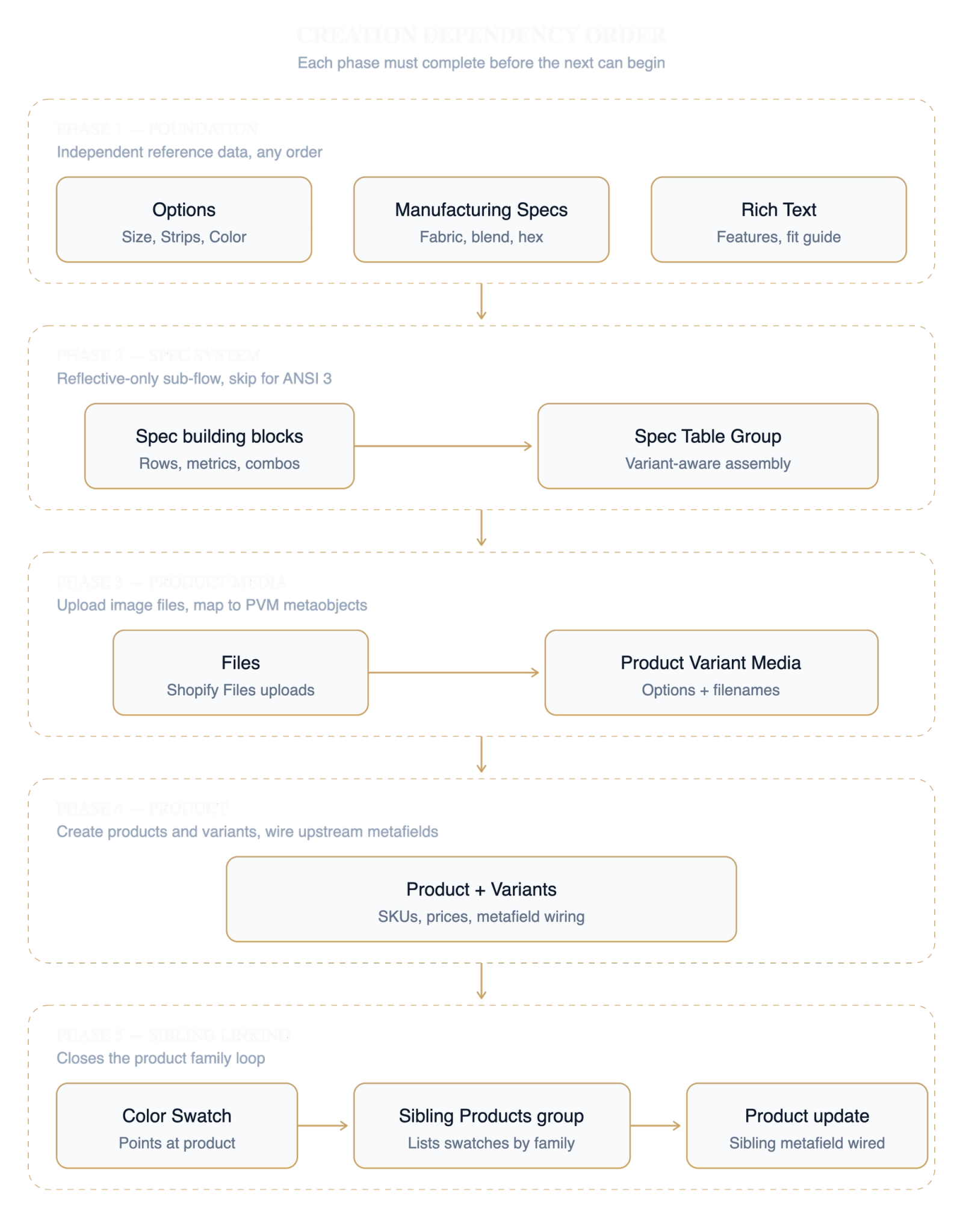
Two proofs that the architecture holds. A Phase 1 normalization pass renamed 412 metaobjects to canonical convention across the catalog with no downtime and no broken storefront references. In the same window, a new ANSI 107 Class 3 line launched: twelve products across two brands, three garment types, and two hi-vis colors, slotted into the schema without a single new metaobject definition. Both are the kind of evolution that snaps clean when the architecture is right or that produces months of cleanup when it is not.
The Catalog Operations SOP and Import Build SOP are living documents that codify every operational lesson from those two projects. The next operator who inherits the catalog inherits the SOPs alongside it.
The Hydrogen storefront.
Miner Strong runs a Shopify Hydrogen (headless) storefront that unifies the D2C checkout experience and the B2B custom-order surface in a single codebase. Every page carries the brand positioning, and every page builds awareness of the custom-order path.
The homepage architecture serves three distinct visitors without confusing any of them: the individual worker, the crew outfitter, and the miner. The hero opens with an eyebrow line the brand runs across every page (Born Underground · Worn Everywhere) and carries the full positioning in seven words: Built for the Mines. Worn Everywhere Else. The subtext qualifies the claim: hi-vis reflective workwear engineered for 7,500 ft underground, overbuilt for everywhere else. Two primary CTAs sit beneath the subtext, one for each of the two dominant paths into the site: Shop ANSI 3 Series for the compliance-driven individual buyer, Outfit a Crew for the B2B custom-order buyer.
The three-visitor routing becomes explicit in a Pick Your Path section immediately below the hero. Three clearly labeled doors: I’m Outfitting Myself (into the Job Site Series no-logo line), I’m Outfitting a Crew (into the custom-order flow), and I’m a Miner (into the Miner Pride heritage collection). No visitor is left guessing which door belongs to them.
The rest of the page carries the visitor through an origin block anchored on coal-mine survival testing, a Job Site Series product row for individual buyers, a crew-outfitting section with example logo work, the Miner Pride Collection for the brand’s loyal base, mixed social proof that pairs reviews from miners with reviews from pavers and utility crews, and a closing CTA that mirrors the frame the hero opened with: One Door for Workers. One for Crews.
The form and the backend flow.
The custom-order intake form is one of the highest-leverage surfaces on the site. It is what routes a visitor’s intent from “I want my crew in this” to a qualified conversation with a real person on the Miner Strong side.
The industry taxonomy was built against Miner Strong’s actual customer base rather than against a generic dropdown. Seven industries, with a write-in Other catching whatever the fixed list misses:
First Responders and Security were deliberately excluded because Miner Strong does not currently sell the product categories those buyers need (tactical pants, breakaway vests). The B2B intake uses Construction & Heavy Civil (the vocabulary of the corporate safety manager writing the PO); the D2C newsletter equivalent uses Construction & Roadwork (the vocabulary of the individual worker signing up for updates on gear). The split is intentional.
The role segmentation is built on the same principle. Six options grouped by purchasing power and intent, with the workforce kept visible at the top so it does not get erased by the corporate categories:
The prompt reads “What’s your role on the job?” rather than “What best describes you?” for the same reason: the copy has to sound like the job site, not like a government census.
The form output feeds a backend lead-prioritization routing pattern. Corporate credit-card decision-makers (safety directors, purchasing, executives) surface on the operations side differently from individual buyers, and both carry the industry taxonomy attached.
The custom-order pipeline is not just a form-to-inbox handoff. It is instrumented so the Miner Strong side knows which conversation to have next.
Simplification and search performance.
The initial launch shipped a sibling-product PDP that reflected the data architecture directly: one unified page that let a buyer choose between shirt colors, strip counts, strip colors, and sizes in a single option matrix. Four decisions on one screen.
Behavioral data surfaced the problem. On mobile especially, the popup-based option UI created serious cognitive load: buyers were making four discrete decisions before they could add to cart, and the mental model asked them to distinguish shirt color (the color of the garment) from strip color (the color of the reflective tape). That distinction is obvious once you have the language for it and confusing before you do. The popup itself made the mobile experience worse by preventing real-time image feedback as options changed.
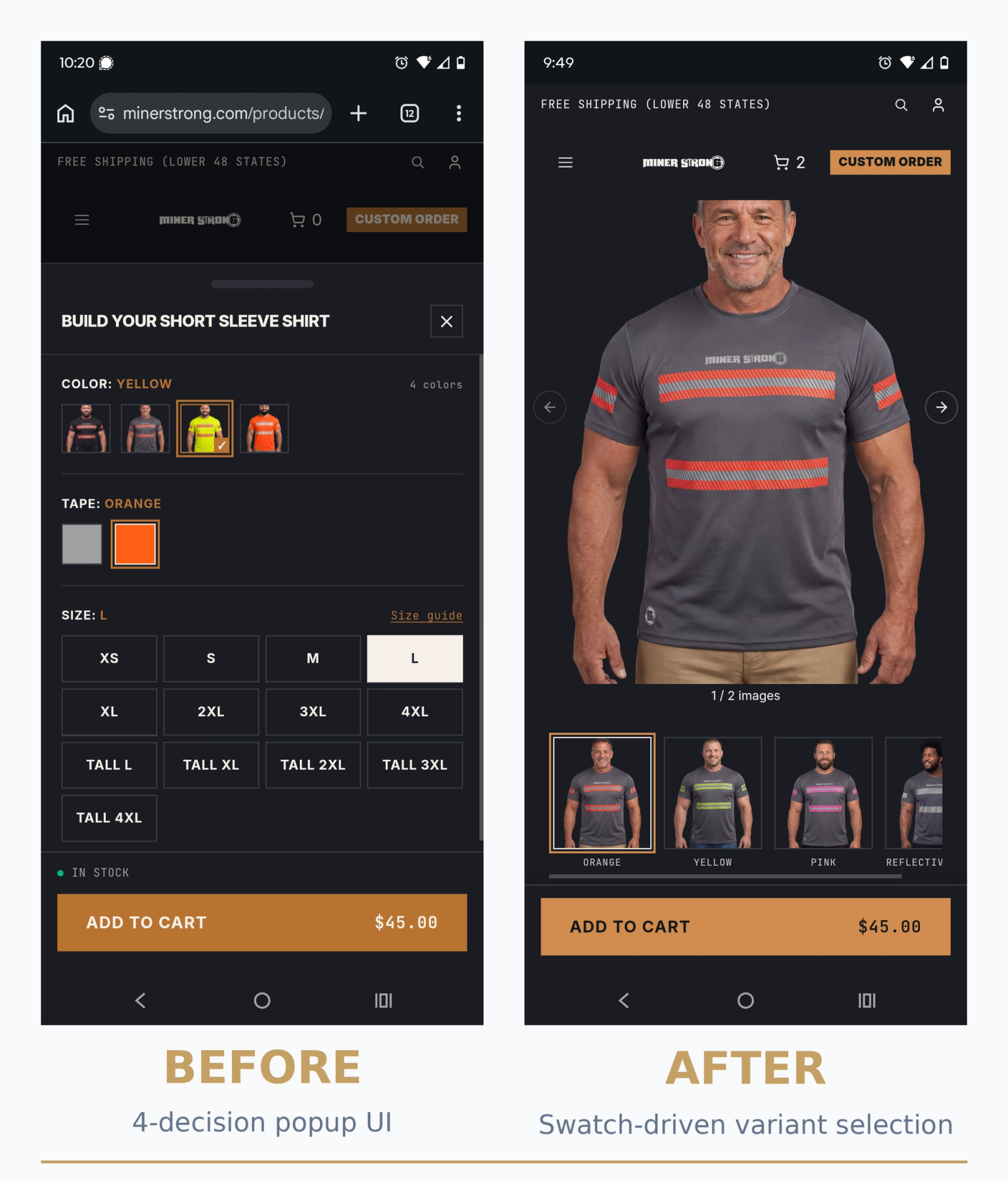
The refactor happened in two data-driven cuts. First, sales data on the 1-strip and 2-strip variants showed a clear winner: the 1-strip option was retired, removing one decision from the flow. Second, shirt color was removed as an in-page option so the swatch thumbnails could carry the strip-color variants instead. Two decisions collapsed into a single visible one. Mobile buyers could now see the swatches and the real-time image updates directly on the page; the previous mobile option popup had sat over the product image and hidden the updates happening beneath it.
On the current site, the collection page surfaces one card per shirt color, each with a single representative image. Each PDP represents one shirt color and presents strip-color variants as thumbnail swatches the buyer can see before they select. Tap a swatch. Pick a size. Add to cart. One visible decision plus size, down from four.
This is where the decoupled data architecture paid off. Because siblings had always been independent products at the data level, the frontend could be refactored from a stitched multi-product experience into a per-color PDP experience without re-architecting the catalog underneath. Same data, different UI. This is the kind of change that lands in days when the data model is built for it and takes months of rework when it is not.
The SEO signal reflects the same underlying discipline. Six-month average ranking position improved by 15%, with recent daily positions continuing to trend better. Core Web Vitals for mobile page experience currently sit at zero URLs in the Poor tier, zero in Needs Improvement, and every measured URL in the Good tier: a full pass on Google’s mobile ranking signals for page speed and interaction quality.
Naming conventions and metaobject discipline are not glamorous work. They are what makes catalog pages both indexable at launch and refactorable years after launch. Both post-launch wins (CRO simplification and SEO position improvement) trace back to architectural decisions made before the first product was created. That same discipline is what let the CRO refactor ship quickly once behavioral data pointed the way, rather than getting stuck rebuilding underlying systems every time a change was worth testing.
The rebrand: Born Underground. Worn Everywhere.
The trigger was empirical rather than aspirational. Meta and Google ad testing on the no-logo Job Site Series against the broader hard-worker audience (construction, paving, logistics, landscaping) surfaced consistent outperformance versus miner-specific creative running into the same audience segments. That result put a genuine strategic question on the table: refocus the brand toward “general industrial safety” and compete for the broader hard-worker segment, or hold the miner identity and expand what the name means.
The call was to hold the identity. Compete against Amazon, Uline, and every commodity high-vis brand on price by going generic, and Miner Strong loses. Compete on the credibility of the origin, and the brand has an asset none of them can copy.
The framing is the Yeti or Carhartt playbook. Extreme-use credibility as the ultimate stress test. If a reflective long-sleeve holds up in a mine at 7,500 feet underground, it is over-engineered for a construction site or a landscaping crew. Old meaning: Miner Strong makes gear for miners. New meaning: Miner Strong makes gear strong enough for miners, available for every hard worker who wants it.
The proof is not marketing copy. The gear is personally tested by the founder underground and by other miners on the job before it is released. The reviews come back from miners saying what the initial tests already found: the gear is good. If it lasts in the mines, the quality is right for any industry, with respect to industry-specific safety standards (ANSI 107 and equivalent) where they apply. That is the credibility anchor that lets the brand talk to a paver or a lineman without diluting the identity.
The rebrand codified a family of positioning lines the brand now runs across the site. The five-word brand line sits in the header eyebrow and in the footer: Born Underground · Worn Everywhere. The homepage hero carries the seven-word positioning: Built for the Mines. Worn Everywhere Else. Longer-form variants (Born in the mines. Built for every job site.) sit on the About page and in supporting copy where they read best. Audience descriptor throughout: America’s hard workers.
The community layer is where the brand keeps its center of gravity even as it expands. Miner Monday, safety-tip sharing, miner stories from the crews using the gear on the job. The story the brand is telling is bigger than the product catalog. It is about one of America’s unsung workforces getting seen.
Mining companies, construction firms, trucking outfits, and industrial employers across the US, Canada, and beyond now outfit their crews in Miner Strong gear with their own company logo printed on it. Miner Strong quality with their brand name on it. And the miners in the workforce are proud to see it there.
Infrastructure first, amplification after.
The typical order-of-operations for a custom-order manufacturer is to build the marketing first, hit a ceiling where the operational reality of custom orders overwhelms the growth, and then retrofit the infrastructure under duress. That path is expensive in cash, in team energy, and in the customer trust that gets spent while the operational fires get put out.
The other path is to build the infrastructure first. Data architecture that can carry every foreseeable product line. A storefront that serves both D2C and B2B custom-order buyers without confusing either one. A custom-order pipeline that routes leads by intent and purchasing power. Then run the marketing amplification into a foundation that can absorb the volume without breaking.
This is the work Frame & Ledger does. Foundational Shopify infrastructure for custom manufacturers, built in the right order, so the amplification lands on something that can hold it.
This case study describes work performed by Frame & Ledger LLC on the Miner Strong LLC engagement.